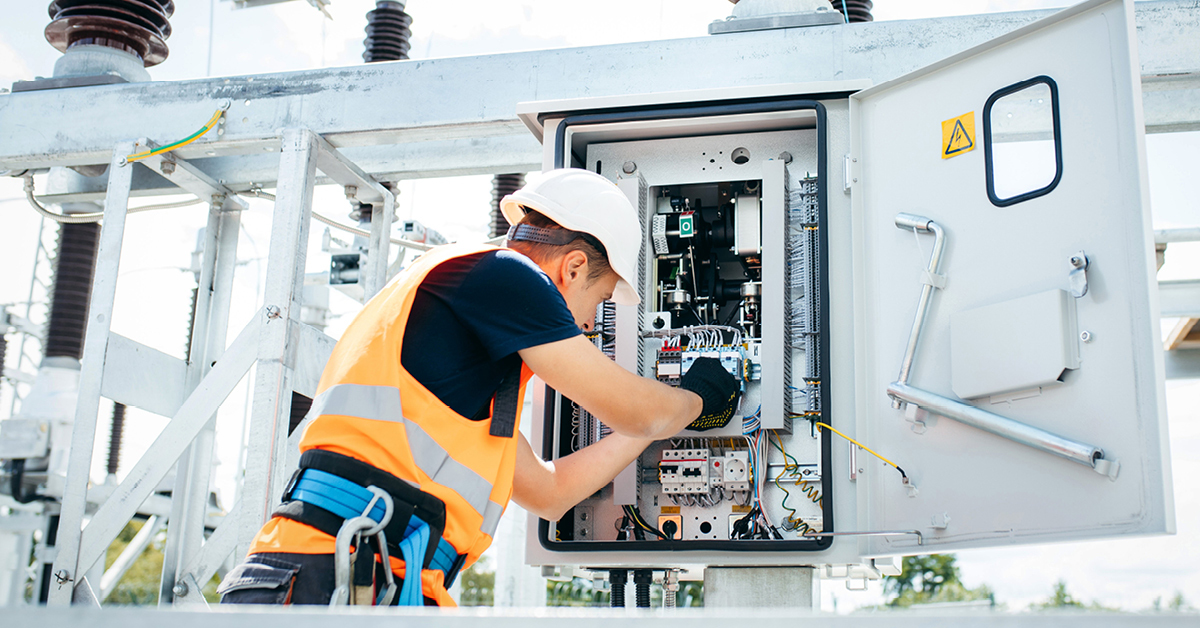



Several recent government policies have underscored the importance of, and commitment to, greening the economy and achieving net-zero emissions. ‘UK Infrastructure: A 10 Year Strategy’ discusses how new infrastructure will support ‘The UK’s Modern Industrial Strategy’, while its ‘Unlocking the benefits of the clean energy economy’ report considers the benefits for the economic and employment prospects of the clean energy sector. The common link among these ambitions is a reliance on the skills and experience of Electrical, Control & Instrumentation (EC&I) specialists, who enable safe and reliable operations, whether in nuclear, renewables, or infrastructure development.
However, as digitalisation increases, more complex project requirements and stringent safety demands will affect how EC&I roles evolve over the next five years. We examine the competencies and responsibilities likely to define these roles for engineers entering or progressing within the discipline, and how organisations can plan to ensure they have the talent they need in the future.
The three main drivers of change
Digitilisation - Industry 4.0 or the Fourth Industrial Revolution is characterised by the increased use of data and connectivity, together with human-machine interaction, analytics, and the evolution of robotics. It’s transforming businesses both in the UK and globally. Used in an increasingly diverse range of industries, such as oil and gas, manufacturing, and renewables, the technologies include Internet of Things (IoT) devices, machine learning, digital twins, cloud computing, and AI. The benefits of digitisation include higher productivity, improved quality, reduced manufacturing errors, increased efficiency, and significant savings in time and money.
EC&I specialists are increasingly expected to extract and analyse the vast quantities of data produced by these applications, and digital skills are now a fundamental requirement of any EC&I professional’s skill set.
Complexity - projects are growing increasingly complex, involving multiple sites, advanced machinery, and intricate processes, all of which require close coordination to ensure that systems remain functional and reliable. Legacy equipment must be connected to modern control systems while maintaining production schedules, budgets must be strictly adhered to, and quality must be consistently delivered. This is occurring against a background of enhanced automation systems, strict regulations, site constraints, and an increased need for collaboration and coordination among teams.
Traditional EC&I competencies, therefore, must be expanded to encompass a range of abilities and soft skills, such as strong communication, ongoing training and development, and enhanced teamwork.
Safety - with many new EC&I roles emerging in high-risk environments such as the nuclear industry, petrochemicals, and chemical processing, safety standards within the sector are becoming increasingly stringent. EC&I professionals must operate with a safety-first mindset at all times in order to ensure not only their own safety but that of their colleagues and the general public, as well as environmental concerns, in line with UK Health & Safety Executive guidelines. The increasing digital aspects of EC&I work necessitate consideration of additional safety requirements when addressing cybersecurity risks and digital vulnerabilities, thereby adding an extra layer of safety.
EC&I professionals must contend with shifting regulatory frameworks, which are designed to guarantee safety, but, as the sector evolves and expectations change, they must also blend this knowledge with an enhanced awareness of digital risks.
The next five years
In the future, we anticipate that EC&I engineers will be required to:
-
Spend more time collaborating across various disciplines with, for example, civil engineers, mechanical process specialists, and software developers. This will require strong communication and documentation skills as well as the ability to clarify and interpret the precise requirements of non-EC&I colleagues.
-
Develop programming skills such as script writing, configuring industrial networks, and solving code-related issues, creating cross-over skills that span IT and traditional engineering.
-
Understand basic cybersecurity issues, such as managing access control, segmenting networks, and recognising potential vulnerabilities, to prevent systems from becoming targets of attacks. Familiarity with system architecture will become essential.
-
Expand the scope of roles to incorporate less traditional skills, such as environmental protection, lifecycle planning, and asset management, to embrace the profession's widening boundaries.
This means that EC&I specialists in the early stages of their careers should seek to expose themselves to as diverse a range of projects as possible, rather than specialising in a single skill set, to broaden their experience. Roles that offer the potential to work on integration or modernisation projects or that provide coordination opportunities will enable early career EC&I professionals to flourish in the future.
Continuous training and development are also essential, especially when they are complementary to traditional EC&I knowledge. They should consider courses in, for example, data visualisation, industrial networking, or project management to broaden their skills and deepen their understanding of the wider sector.
More experienced professionals should also pursue learning and development to ensure that their rewards match their seniority and experience.
How JAM Recruitment can support your organisation for the future
If you’re an employer that’s reliant on skilled EC&I professionals, you may be finding the changing pace of the skills involved in the sector difficult to keep up with. You might understand that you need someone with advanced control systems knowledge or familiarity with data integration, but you may not know what the roles encompass or how to source the talent you need.
At JAM Recruitment, we understand these seismic shifts and can help your organisation in a variety of ways. We can:
-
Identify candidates with the combination of emerging skills that employers need
-
Map industry trends to enable you to understand how EC&I roles are evolving
-
Help you to anticipate future skills needs and identify which transferable skills can be sourced in other disciplines to widen your talent pool.
-
Advise you if you need to invest in training and upskilling or recruit externally.
-
Support candidates in understanding what they need to do to acquire the skills they’ll need for future roles.
Looking ahead
With 25 years’ experience in the engineering and technology sectors, JAM Recruitment supports employers who wish to build resilience and agility into their workforce and future-proof themselves against the technology of tomorrow. We specialise in connecting skilled EC&I contract and permanent professionals with organisations undergoing rapid and significant transition. Contact us to discuss how we can help your organisation anticipate the skills and technological knowledge you’ll need in the future.